Everglades 99 Naturist Camping Trek
(Six days and 60 miles clothing-free in the Everglades National Park!)[contains nude images]- - -
"Tourist Shot" at Highland Beach on the Gulf of Mexico
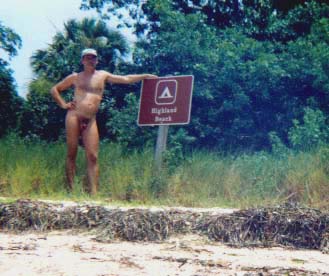
After Realizing that it had been almost two years since I had made a long term (a week or more) wilderness camping trip, My wife Patty and I decided I should do something about it.
I quickly narrowed the possibilities down to a backpacking trip on the Appalachian Trail, or a boat camping trip. Knowing I was out of shape for a major backpacking trip, I decided to take a "practice hike" with a full pack to see how much conditioning I would need. I was shocked that a 4 hour hike at a slow pace wiped me out for a couple of days. I would need more conditioning to do the Appalachian Trail than I had time to do, so I decided on the boat trip. I decided to "round out" my Everglades camping experience by visiting the last part of the National Park which I had not yet visited -right in the middle. (I had visited the North and South ends of the park on previous visits.)
SUNDAY AUG 1 (DAY 1)
I planned out a six day tentative trip (you have to make reservations when you arrive to use backcountry campsites, so extensive preplanning is not possible). As it turned out, no one else had made any reservations at all recently. In fact the ranger had to start a new book for my reservations. While she was doing this, two other rangers came in and were surprised to see someone getting a backcountry permit. They were much more surprised to find I was going for six days. My plans were "locked in".
There is a myth that it is too hot and buggie in the Everglades National Park in the summertime. As a naturist, the heat is not as much of a factor as it might be for a textile camper, and the bugs are easily managed with repellent and by not going outside the tent at night.
All the paperwork out of the way, it was time to launch the boat (a 12 foot V-hull) and park my Toyota truck. I parked at a campground on the Barron River for $5.00 including the boat launch and 6 days of parking.
The Barron River empties into Chokoloskee Bay. A marked channel extends across the bay to the Gulf of Mexico. Since the weather was forecast to be good, I took the Gulf route rather than the longer, winding inland route to my first campsite which was on a Gulf island called Pavillion Key.
As soon as I was clear of the Barron River, I changed into my naturist "uniform". I kept a towel in reach in case I met another boat while in the relatively narrow marked channel to the Gulf. About a mile from the Gulf, the towel got used when a tour boat appeared around the bend ahead, heading back inland with a load of park visitors (it's not nice to freak out the tourists).
On reaching the last marker and the open Gulf, I turned South and followed the indicator on my hand-held GPS (the island was beyond the horizon). After dabbing on a little extra sunscreen and packing away the towel, I settled in for an uneventful run to my first campsite. According to the GPS, it was an hour and a half away.
Not 10 minutes later, I noticed a boat coming from the direction of a small island to the East of me. It appeared to be on an intercept course, and was gaining rapidly. I considered digging out the towel and wrapping in it again, but decided with all the open water around, there was no reason they had to approach closely unless they wanted to. If they really wanted to meet me that much, I decided they could meet the "real" me. (After all, they would be imposing on my solitude. I would not be imposing my nudity on them, since they were approaching by choice.) I simply held my course and ignored their approach.
As the boat came alongside, I noticed it was a Park Service patrol boat. I cut my throttle and killed my engine as they did the same. Two of the rangers I had spoken with earlier were on board. One asked if I was headed for Pavillion Key and if I had a permit. The other ranger noticed the ball cap I was wearing (I don't like putting sunscreen on my head). I had been wearing the hat at the reservation office, and it has a Christian radio station's name on it. This ranger said "You're the guy from Zephyrhills." I agreed with his observation.
They asked if everything was ok, and if I knew the way to the island. I told them my GPS said it was "that way" (pointing). They agreed and told me to have a nice trip, and waited for me to restart my motor before taking off themselves. Not a word was said about my being nude, which was pretty obvious in the open boat.
- - -
An hour or so later, I got my first sight of Pavillion Key.
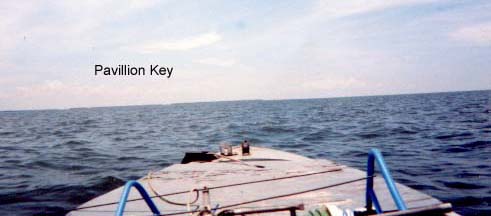
- - -
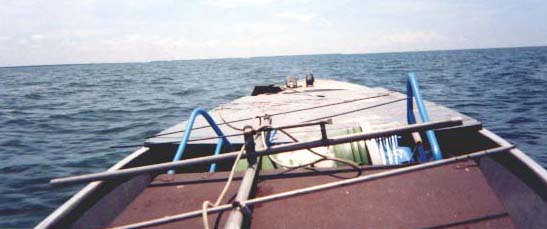
This will give you an idea of how packed the boat was. The island is about twice as close now.
- - -
The rest of the trip was uneventful. As I arrived at the island, a fishing boat departed.
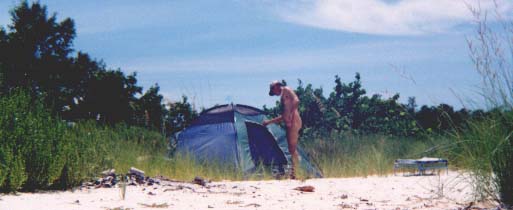
I proceeded to set up my campsite on the Northern shore of the island. The sand was not yet hot from the sun, so I set up my tent first to keep the floor cool.
- - -
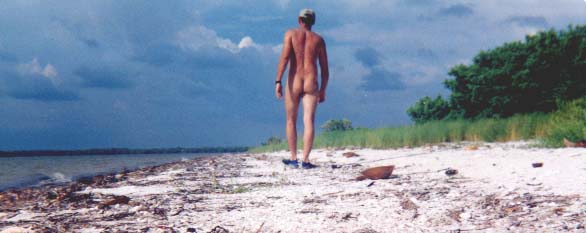
After setting up camp, I was able to thoroughly explore the island. Around the grassy area the beach curved to the right and continued on a quarter mile or so.
- - -
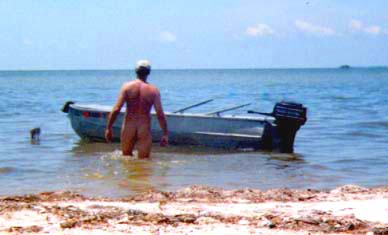
Did I leave the sunscreen in the boat? (Note the Mercury 9.9 HP motor)
- - -
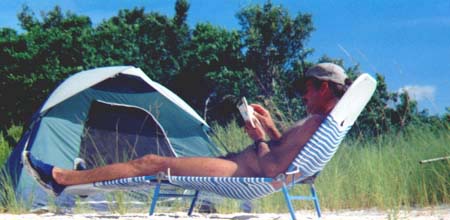
Finally, I was able to start a serious "power lounging" session
- - -
MONDAY AUG 2 (DAY 2)
The day started on an interesting note. After fully loading the boat, I tried to start the Mercury 9.9 Hp motor. The starter rope came out in my hand. The recoil housing would not open to allow me to replace the rope, so I had to use my spare engine (an Evinrude 4 Hp motor). Of course, this meant unloading most of the gear to get the Evinrude and to stow the Mercury.
After switching motors, I proceeded toward the next destination - Highland Beach. My speed was only reduced by about 2 miles per hour from the larger motor's speed. I was surprised how small a difference it was. The approach to the beach (located on McLaughlin Key) was uneventful. After half an hour or so, Highland Beach peeked up over the horizon. It was nine miles away in this picture.
- - -
The island from two miles away. The sand of the beach is now visible.
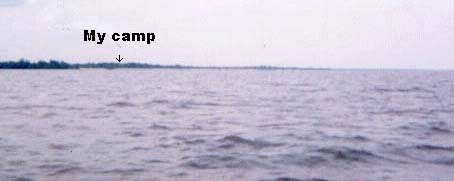
- - -
I arrived at Highland Beach at low tide. Fortunately, it was rising, so I didn't have to wait too long for the water to be deep enough to land the boat. While I was waiting, I walked ashore and looked for a campsite. I wanted to set up my tent before the sand underneath got too hot from the sun. After a short walk, I found what appeared to be the drag mark of a canoe keel which had been dragged up from the water. At the end of this drag mark was a decent campsite.
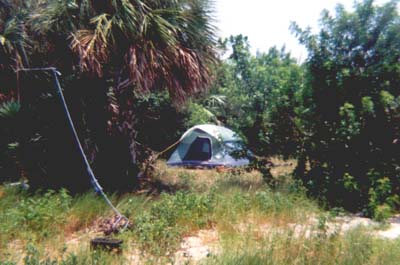
Eventually, the tide was high enough to bring the boat to the site and unload the rest of my gear. After bringing everything ashore, I set up my ham radio and antenna. I pointed the antenna toward Big Pine Key, which is about 50 miles away as the seagull flies (there is a ham radio repeater station there, which normally has excellent range, allowing me to make contacts all over the keys). I also set up two signs, each about 100 yards from my campsite in each direction to advise anyone who might land that I was camping nude. Turned out the signs were totally unnecessary. No one else landed and walked the beach the two days I was there.
This is the campsite on Highland each. Note the antenna pointing toward Big Pine Key. The rope is to keep it from swinging in the wind.
- - -
With camp all set up, and it still being early in the afternoon, I decided it was time to do some beach hiking. I found out (using my GPS) that the beach is about 2.7 miles long, making it a nice 5.4 mile hike altogether (and in the altogether for that matter). In the course of this hike, I found that most of the "good" campsites are from the middle of the beach southward. My site seemed to be the only good one at the north end.
After the hike, it was time for more power lounging - reading in the lawn chair and listening to the shortwave radio, literally in the shade of a palm tree with a nice seabreeze. (It's rough, but someone has to do it.) Supper was canned, and only had to be heated and opened, so it was a real laidback afternoon, with supper being solar heated in its can on the beach.
The next major event was the afternoon thunderstorm. It was late enough in the day that I knew I needed to take dinner inside the tent, and not come out till morning. (To avoid mosquitoes, you really need to be in your tent about a half hour before sunset.)
After the storm, but just before dark, I saw a sight I have never seen in the Everglades before. A medium sized white tail doe came walking casually down the beach, passing about 20 feet in front of my tent. She stopped and looked at the tent, with curiosity, but no sign of fear. My inner door was open, so we made eye contact through the screen door for several seconds before she continued her casual stroll down the beach. The whole time I saw her, she was periodically twitching her muscles under the skin to ward off the yellow flies that were accompanying her. I would not have been surprised by one of the minature "key deer", but this was a normal size white tail.
The last surprise of the day was the call of an owl which I had only previously heard in the Florida interior way to the north - never before in the Everglades.
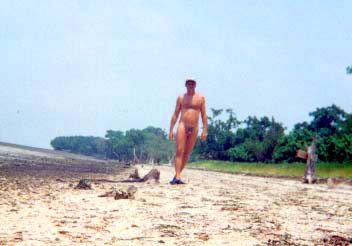
Hiking the beach. Note the back of one of my signs to the right.
- - -
TUESDAY AUG 3 (DAY 3)
This was my designated "goof off" day. Nothing planned except for sleeping in, power lounging, swimming, and enjoying the peace and quiet. I had planned no travelling, so I could even leave the tent up and didn't have to load or unload the boat - sort of a vacation within a vacation.
The day began with an intense thunderstorm. I was seriously concerned about the tent tearing in the wind, but it was fine. Just as the rain was starting, a motorboat came by within 50 feet of the tent (the tide was high). They went a little farther south to a point just beyond where my sign was. They waited out the storm (about an hour) before returning back toward the north. I guess they just went back where they had come from. I went down the beach to see if anything had blown ashore from the storm. I saw nothing special except that my sign was missing. If it had been blown down, it would have been on the ground back from the beach, since the wind was blowing ashore. I never found the sign, and wonder if the boaters took it as a "souvenier".
Later on, after it had cleared, I noticed several of the drag marks I had noticed when I first came ashore the day before. They definitely were not canoe keel marks, since I know that no canoes landed in the last 24 hours, and the storm would have washed the marks away if they had. These marks were left after the storm. Later, I saw what was making them. An alligator was floating out in the surf, of all things! I knew that there were Florida crocodiles in Florida Bay (about 40 miles south), but I had never heard of alligators in the Gulf of Mexico! It seems that an alligator had picked out my campsite for me.
As planned, most of the day was spent power lounging. This was good, because it didn't use my full gallon of drinking water allotted for the day. (In summer in the 'glades, it is advisable to drink one gallon of water per person per day, since you will be sweating a lot more than you think when you excert yourself). One of my water jugs had been punctured on the first day and a good bit of water had leaked out. This day of power lounging brought me back up to par on water consumption. Lying in the shade in a lawn chair reading and listening to the radio with a seabreeze blowing doesn't work up much sweat.
Most of the day it was somewhat overcast, so I didn't do much swimming until sometime in the afternoon when the sky did clear a bit. The tide was low until later in the afternoon as well, so actual swimming would have been difficult anyway. It would be more like wallowing in the mud than swimming.
One disappointment with this location was the total lack of success with the Ham radio. On other Everglades trips, I have always been able to make contacts from my campsites, but it just wasn't in the cards Monday or Tuesday.
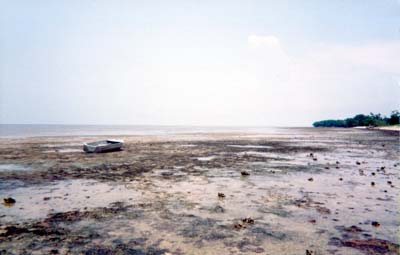
Highland Beach has a rather marked tide variation. At high tide, the water came within 20 feet of my tent, but at low tide it really gets low. I anchored my boat about 100 feet offshore to keep my water supply safe from racoons Monday night. Next day, I saw the boat grounded like this during the low tide. (Luckily, the coons had not found my water. I moved it into my tent after seeing this.)
Later in the day the sky clouded up again, but the rain stayed to the north and south of me. I took advantage of the overcast to again walk the beach a bit and look for any unusual shells or anything (maybe even my sign). On the return to my campsite, I heard another motorboat approaching from the south. Since it was still a couple of hours from high tide, I didn't figure they would pass near the shore, so I didn't try to get out of sight or anything. Well, they somehow did manage to pass closer to shore than I expected, and the driver seemed somewhat surprised at the nude guy walking the beach - judging by the way he turned nearly all the way around in his seat as he passed. Oh well.
- - -
WEDNESDAY AUG 4 (DAY 4)
This day started without the rain, which was a welcome relief, since I had 15 miles to travel to my next campsite. I was going inland up the Lostman's River to Plate Creek Bay. Plate Creek has a chickee for camping. I had seen it in the distance on previous visits to the 'glades, but never used it before.
As I entered the Lostman's River, clouds began building in the entire sky to the west of me. Within a few minutes, it started raining. My map showed I needed to get through a long narrow bay and past a peninsula before I would meet the Wilderness Waterway, which has numbered markers to show the way. The rain was soon so intense, I could not see more than 100 feet or so. I had to anchor to make sure I did not miss the junction with the waterway.
After about 45 minutes of sitting at anchor and bailing rain out of the boat, the rain let up to barely a drizzle. I was about 100 feet from the nearest marker. I would have never seen it in the rain. I continued on toward Plate Creek, getting new waves of rain every half hour or so.
The trip from the Gulf to Plate Creek Bay passes through Plate Creek and another unnamed creek, both of which wind through the mangroves, making for a scenic trip. I had a wet, somewhat chilly scenic trip. I had not counted on being too cool in August in the Everglades!
On arriving at Plate Creek Bay, the sun emerged and warmed things quickly. I took the opportunity to hang things out to dry.
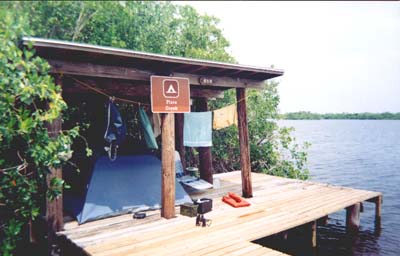
I soon warmed up as well, and had to seek shade under the chickee roof. My Wilderness Waterway guidebook suggested that the water in Plate Creek Bay was fresh rather than salty or brackish. I tasted a drop and found it to be correct. I took the opportunity to wash a couple of my towels which were saturated with salt from the Gulf and/or sweat. With my dinner (black bean soup) set out in the sun to solar cook, I set up the Ham radio station, then settled in for some more power lounging.
- - -
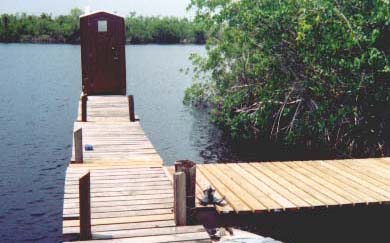
The amenities at the chickee included a freshly serviced Port-a-john. Notice the can lying on the boardwalk. This was my dinner solar cooking. The other object on the boardwalk is my anchor.
- - -
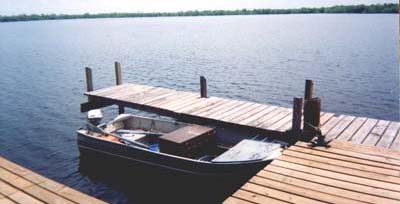
The docking facilities at the chickee were fairly deluxe as well. There was room for two boats, though I can't imagine two parties trying to share this shelter.
- - -
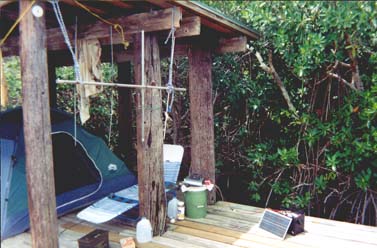
The Ham Radio setup. The antenna was aimed at Miami (about 50 miles across the Everglades from Plate Creek Bay). The solar-panel-looking thing on the right is a solar panel for charging the 12 volt deep cycle battery.
- - -
THURSDAY AUG 5 (DAY 5)
This morning thanks to a helpful Ham operator in Miami, I was able to get a message to my wife for the first time during the trip. I let her know everything was on schedule and all ok. (She hadn't heard from me for 4 days, but knew I might or might not be able to make contacts on the radio.)
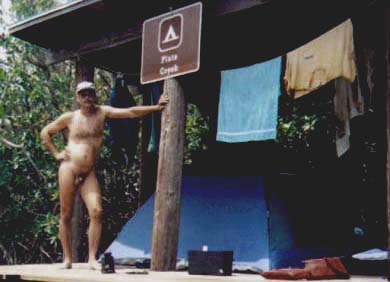
After the radio contact, a quick breakfast and a "tourist shot" by the sign, it was time to pack up and leave for the next destination: the Sunday Bay chickee.
- - -
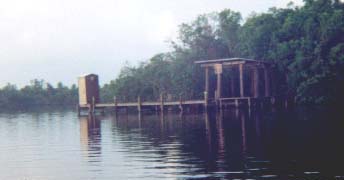
A parting look at the Plate Creek Chickee. Notice the sky has already clouded up.
- - -
Before I could even cross Plate Creek Bay, the rain started again. It was mostly light rather than the blinding rain of the day before, so I could continue motoring. The rain may have actually kept the bugs down somewhat as I motored through Alligator Creek. This creek is very narrow and twisty, and you must go at idle speed, so the bugs can really swarm you if conditions are right. (I had no problems.)
Knowing that this whole day would be spent on the Wilderness Waterway itself (sort of the main highway for boats in the Park), I wondered if I would be meeting any boats. I had a towel handy in case of close encounters, but met no boats all day.
By the time I reached Sunday Bay (about 12 miles), a wind had started up. Fortunately, the wind was from slightly behind and to the left of me, so it actually "helped" me across the bay rather than making it rough.
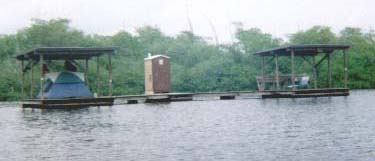
The Sunday Bay chickee is located behind an island near the northern shore of the bay. Although the bay was becoming choppy, near the chickee it was glassy.
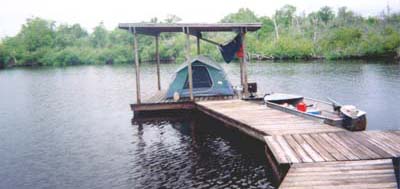
The rain kept coming and going in waves. It had just stopped when I arrived, so I quickly set up my tent. The thing hanging in the rafters is a duffel bag drying out.
- - -
Unloading the rest of the gear during a break in the rain.
- - -
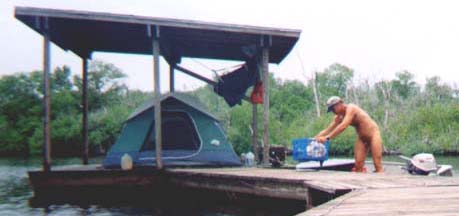
Sunday Bay chickee is a double chickee. During peak use times, each side would be used by different parties. If you want to try naturist camping any time other than Summer, you might want to use single chickees (like Plate Creek). Otherwise you might have to share fairly close quarters with non-naturists. Since I had the whole site, I used the other platform as my "power lounging" area, as evidenced by my lawnchair.
- - -
Though it stayed overcast all morning, the rain subsided to waves of light sprinkles only. The day warmed up nicely without getting overly hot. Just at dark, another storm moved through with a fair amount of wind, but did not last long.
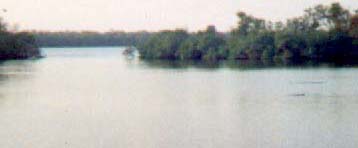
Several times during the day, I heard splashes and saw that bottlenose dolphins (or porpoises if you prefer) were swimming around the chickee. Of course they knew exactly when I had a camera ready and would disappear until I put the camera away. I almost caught two dolphins on film here (to the right of the picture), but as I was snapping the shutter, they submerged. This was the best I could do. Interestingly, about 100 yards from the dolphins, an alligator was floating lazily, but the sun had come out and was at the wrong angle to get a gator picture. (The water here was brackish - about half salt and half fresh.)
- - -
Friday AUG 6 (DAY 6)
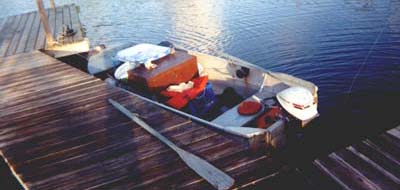
This was an interesting day - in the chinese sense. (There is an old Chinese curse - May you live in interesting times.) It started out uneventfully enough. No rain. No clouds - just a nice blue sky. The tent went down and gear was packed uneventfully. Note just how full the boat was. And bear in mind that my 9.9 HP Mercury motor is on the floor of the front end of the boat - under all that other gear. Not in the picture is my Ham antenna. It was lying on the dock behind me, but it went on top of the other things in the bow of the boat. (Note the Evinrude 4 HP motor.)
Well, I got underway and everything was fine. I proceeded down the Lopez River, which connects Sunday Bay with Chokoloskee Bay. Everglades City and my truck were at the far end of Chokoloskee Bay (about 9 miles from Sunday Bay).
"Down" one of these rivers has a different meaning from "down" an inland river. Usually "down" means with the current. Here "down" means toward the Gulf of Mexico. As the tide changes, so does the flow of the river. Since the tide was rising, I was going down the river against the current.
All was well until I reached an obvious intersection of the Lopez River and another body of water. Normally, when there is a juction like this, a marker points the correct way. In the absense of a marker, you normally continue in the direction you are going until you see the next marker.
Well, seems this marker was missing. When the water began curving to the East where my map showed it only going West, Southwest, or Northwest, I knew I had gone the wrong way. As if to agree with my conclusion, my motor suddenly began running an extremely high rpm and I slowed down abruptly. Sure signs of a sheared pin. Although my oar confirmed I was in water at least 4 feet deep, something had hit my propeller.
After replacing the shear pin, the motor still would not run properly. Apparently the drive shaft had been stripped (that's exactly what the shear pin is supposed to prevent!!).
I dug out my other motor, mounted it on the transom while floating at anchor, and tried again to get the recoil mechanism to come off so I could put the pull rope back on. No luck.
I began rowing back toward the last river junction. I figured it might take all day, but I'd still get back to the truck rowing. While I rowed, I heard two motorboats go by on the Lopez River. I thought - worst case, if I got to the river at least, maybe someone would tow me.
After 45 minutes or so of rowing, one of the metal oar locks snapped off! It's a bit impossible to row with one oar, so I stood in the center of the boat and tried to paddle on one side, then the other. This might have worked if the wind hadn't decided to start blowing against me. During the amount of time it took to paddle on one side and switch, the wind destroyed any headway I made.
I dropped anchor and considered options (not many available). I got a piece of rope and tied it through the hole the oarlock had fit into, and around the oar. Then I proceeded to continue rowing back toward the river. By the time I got there, the hand gripping the makeshift oar was thoroughly blistered. Rowing back the remaining 7 miles or so didn't seem quite as attractive as before.
Within minutes of reaching the river channel, I heard a boat approaching from downriver. I stood up and wrapped a large towel around my waist just as the boat appeared around the bend. When they saw my motor tipped up out of the water, they stopped and asked if they could help. They then tried their hands at loosening the screws on my recoil housing. No luck. (I was finally able to remove these screws at home only with a #3 Phillips screwdriver AND a pipe wrench to turn it while the motor was secured in place!)
Then from the opposite direction, another boat approaches. They also stop and ask what's wrong and try to loosen the screws with no luck. They inform me that they are heading back in and can tow me if I want. PRAISE THE LORD!
As the driver is getting his rope out, they ask about where I have been, and are surprised to find I have been camping for the last 6 days and have not been fishing. They asked about fishing several times, apparently not believing I could be there for six days without fishing SOME time.
Because their tow rope was short, we couldn't go much faster than my boat had been going before the motor broke. I took the towel off to get what last "rays" I could from the sun. Being directly behind the other boat, my footlocker blocked their view of me sitting. The fishermen took the opportunity to do some trolling.
Unfortunately, one of them snagged his lure in a bush, and they made a wide 360 degree turn to recover it. After he had his lure, they swung toward the center of the channel, but my boat followed their original course and went right into the bush. One of the metal elements broke off my Ham antenna in the process, and one of my water shoes was knocked overboard.
Other than that, it was an uneventful trip to Chokoloskee Island where the other boaters were parked. As we neared the houses on the island, I got dressed so as not to offend anyone, and because I figured I would have to walk 3 miles or so along the road to get to my truck.
When we reached the dock at Chokoloskee, the boat driver asked if I needed a ride to Everglades City. I told him I would appreciate it, and gave him the rest of my fuel to use in his boat. He took me to my truck and waited until he saw it start before he returned to Chokoloskee.
After that, it was just a matter of driving to Chokoloskee and loading up the boat. Nothing out of the ordinary except that I only had one shoe to go home in.
Can't wait for the next trip!!!!!!!

