Cabin Boat Camping
This has GOT to be the easiest form of naturist camping. Perhaps the term "camping" is a bit strained here. Nevertheless, you must still provide your food, water, and sanitation as with other camping.
A surprisingly large percentage of cabin boaters are routinely nude aboard their boats once well away from the marina, even though most of them would not otherwise consider themselves nudists. (The percentage is even higher among sailboaters and salt-water rowers.)
Like skinny dipping, nude boating just makes sense. Why be out in all that fresh air, sunshine, and open water with sweaty clothes or a soggy swimsuit?
When choosing a cabin boat campsite, you need to be aware of expected weather, boat traffic patterns, your boat's draft (how deep it sits in the water when loaded), tides and/or currents, and local restrictions (if any).
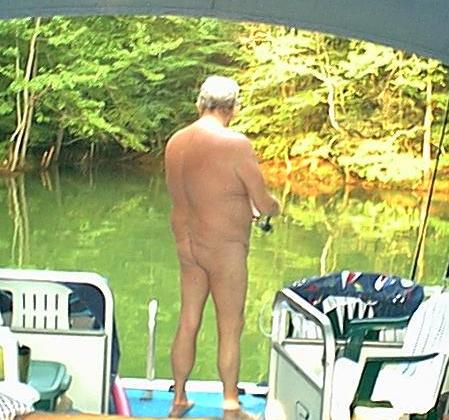
Generally, you want to anchor in an area protected from the expected prevailing wind as much as practical. Often sandbars or large clups of aquatic plants can suffice. They don't actually block the wind, but they can protect the boat from wave action. If getting blockage from the wind is not practical, anchor in deeper areas (shallow water makes rougher waves than deeper water with the same wind). Use at least a 7:1 ratio of anchor rope length for the water depth. Don't forget to use an anchor light (a light high up on the boat to make it visible to passing boats at night).
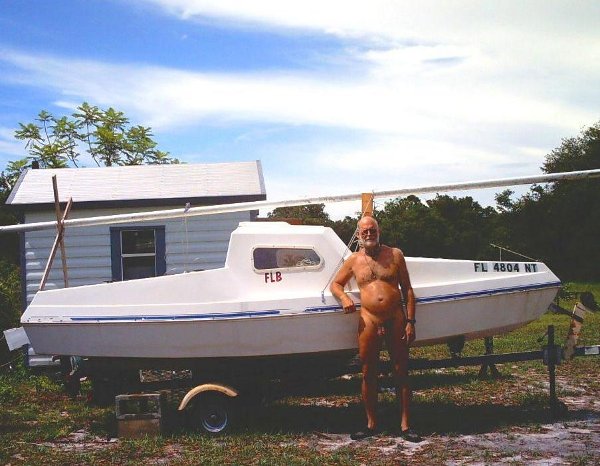
Don't anchor in busy areas. You may create a navigation hazard, and you could more easily offend people since no one is going to expect to encounter nudity in a high traffic area. Anchoring 'away from it all' eliminates both of these problems
If someone does approach you when you're off the beaten path, and if you're really shy, you can always go in the cabin, but frankly, if they are coming out of their way to see you, they probably aren't going to be offended if you're naked.
I've been approached by the Coast Guard asking about an overdue boat, checked by the Marine Patrol for fishing license and safety equipment, and checked by Park Rangers for camping permits while I have been nude aboard my boat, and no one batted an eye or said a word about my nakedness.
Getting back to basic camping needs, assume that any water you are floating on is unfit to drink. Bring bottled water, or boil the water before you drink it. You can also use purification tablets to treat fresh water. (Be aware that while boiling or tablets will kill bacteria, they generally will not remove toxic material from the water, nor will they remove salt. If there is a chance there is mercury or other contamination in the water, you should just bring enough bottled water to drink and cook.
When cooking on board, be sure to use adequate ventilation. Leave all windows open. You might want to cook out on deck. If you cook in the cabin, it would be a good idea to use a sterno stove. The fuel is in gelled form and is not likely to spill or explode.
Use an electric light inside rather than a lantern. The fumes can be a serious problem in an enclosed cabin.
Sanitation is a must. Many boats have chemical toilets on board. Portable chemical toilets can be purchased at stores like Walmart and Kmart, or camping supply stores.
At the very least, you should have a durable 5 gallon bucket with a sealing lid (many restaurants discard containers like this every day - you might get one free for the asking).
The same stores that sell the chemical toilets generally sell the chemicals. About 4 ounces of the chemical in the 5 gallon bucket will control odor, and liquify solid waste for disposal. The lid will prevent sloshing as well as provide control odor. After your trip, dispose the contents in your home bathroom, or use an approved holding tank dumping station.

