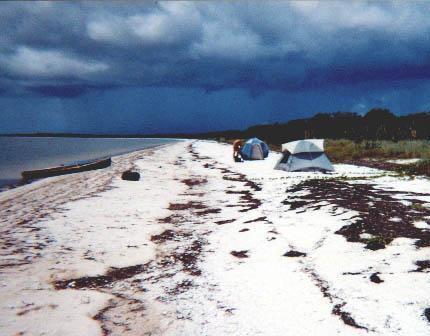
The Pontoon Palace is just out of view to the left
Fellow Adventure Naturists David, Barb, Jason and me went South this year. About as far south as you can drive without crossing a bridge. We met in Flamingo (the most southern settlement on the Florida peninsula) on Saturday afternoon, September 7. Jason and I brought my 14 foot canoe, and David and Barb brought the "Pontoon Palace", a 24 foot pontoon boat.
After David and Barb added the screen walls and fabric top to the Pontoon Palace (PP), Jason and I loaded on our gear, and launched the canoe. We used the canoe as a "storage trailer" for the extra gas and water.
Once aboard, we headed out into Florida Bay. When we were out of the narrow channel, off came the clothes. (Or in my case, the towel. I had decided to make the 7 hour drive to Flamingo without clothing, using my "velcro special" towel. I had a pair of shorts under the seat in case I got broke down or something.)
It was around 5 PM when we left Flamingo, so we looked for an island nearby with enough depth on the downwind side to anchor on (2 or more feet). We settled on the northwest side of Murray key - 2.7 miles out in the bay from Flamingo.
One of the distinguishing features of the Everglades National Park (ENP) is the abundace of mosquitoes. During the previous 9 years of summertime camping in the ENP, I have established that the mosquitoes are quite tolerable provided that:
1 You use a repellent with about 18 percent or more DEET
2 You have a "tight" tent with no see-um screens, and stay in the tent from before dusk till after dawn
3 You stay out of the deep vegetation at all times.
Unfortunately, the PP was not "tight". We hoped that being on the water, the breeze would be enough to keep the skeeters from finding all the openings in the screening. IT WASN'T. Still, a bed-time bath of repellent, and another dose midway thru the nite made it bearable for David and me, but not for our human "baits" (Barb and Jason).
I must comment that in 9 years of ENP summer camping, this is only the second trip where a breeze did not blow all night long.
The next day, Jason and I expected that we would be relocating to another location. We discussed Cape Sable or going "inside" (the Whitewater Bay area). We were surprised to find David and Barb were quite content to stay 2.7 miles out from dock (after trvelling hundreds of miles to get there). We figured they'd want to see all they could in the time available.
It eventually became apparent that we would not be relocating. Besides discusing metaphysics and radio licensing policies with David, I took the opportunity to "test drive" one of his sail sticks and inflated kayaks. Most unique.Jason and I also took the opportunity to circumnavigate a couple of nearby islands with my canoe (and its 3.5 HP kicker)
As a long-time Ham Radio operator (over 25 years), I have always enjoyed the juxtaposition of being way out in the middle of nowhere, and using minimal equipment, still being "plugged in" to the rest of the world.
This trip was planned to be no exception. As it turned out however, Jason and I had managed to clutter up David and Barb's nice "ship shape" deck arrangement with our milk crates, duffel bag, and non-standard sized totes, and I was hesitant to string antenna and power connections, further increasing the clutter.
I decided to just keep the radio gear stowed unless we ran into a problem and needed to call for help. Fortunately, even with THE STORM, we didn't need to. The radio gear stayed packed.
As evening approached, we battened down the hatches (bug screens), and hoped the normal all-night breeze would set in. IT DIDN'T. The human "sacrificial anodes" (Barb and Jason) kept most of the bugs away from David and me, but it still took two repellant baths to get thru the night.
In the morning, I told David I'd gotten more skeeter bites in the last two nights than I had in the previous 9 years of ENP trips combined. Jason had had more than enough of "attempting" to sleep on the PP and wanted to get to a beach or chickee so he could use his tent.I found myself in agreement with the concept, and after hearing about predicted South winds suggested going "inside" again.
Somehow we ended up deciding to go to East Cape Sable instead. At least Jason and I would be able to put up our tents on the beach and sleep bug-free! (And the seabreeze at the beach would probably keep skeeters out of the PP for poor Barb!)
Since we were now planning to use one of the ENP campsites, we needed a backcountry permit. Rather than use the extra fuel it would take for the PP to go back to Flamingo, then back out to Cape Sable, I volunteered to take my canoe and do the trip to Flamingo myself. (I am familiar with the permit process, so I could pretty much get in there, get the permit and get back on the water in minimal time.)So, towel in hand, I headed to Flamingo at sizzling 5-6 MPH and arrived in about 30 mnutes. I wrapped up in the towel, and went into the visitor center to do the paperwork.
This was the week after Labor Day and was Monday again. The place was deserted. I could have done the paperwork nude and no one would have noticed. (Of course, Murphy's law clearly dictates that had I BEEN nude in the visitor center, a bus of school kids on a field trip would have chosen that moment to arrive - or something equally disatrous!)
Anyway, permit in hand, I headed back out in the canoe.
Meanwhile, back at the ranch (or the PP anyway), they got out of the shallows before the outgoing tide got too low, and into the deeper channel heading toward Cape Sable. They then drifted and waited for my return. We were able to get a little test of our FRS walkie talkies as I approached. Despite the packaging claim of two miles, we only got about 3/4 miles - over open water with no obstructions (in other words, ideal conditions). This was a disappointment, since I have seen much better performance with other low power radios including other FRS radios. (Oh well, the price was right - $9.95.)
Once back aboard the PP, we got out the Nav chart and followed the shoreline as close as we could without getting too shallow. After a nice, relatively short trip (only running aground once), we arrived at East Cape Sable. We went around the southernmost point slightly to just the other side of an old pier. We figured we'd get at least a little wind break that way.
Before we could even set the PP's anchor properly, a fishing boat appeared around the south end of the cape, then with all that open water and miles of empty beach, stopped maybe 100 feet from us!
Since they had essentially invaded our privacy, I wasn't too worried about "covering up". I continued helping with the anchoring and other activities of getting the canoe and tents on shore.
The fisher-folk didn't stay long. Either they weren't getting any bites, or they noticed we were naked, or both. (I had actually hoped they'd join us in a little skinny dipping. It has happened on previous trips of mine, but this time it was not to be. Too bad.)
Once that boat left, no one else "dropped in". A few boats went past out beyond the shallows, but not excessively close.
Cape Sable has three main beaches: East Cape, Middle Cape, and Northwest Cape. In between these areas, mangroves go all the way down to the water. So although Cape Sable is quite huge, it is not a continuous shoreline. The Cape is entirely undeveloped for all practical purposes (there is the old pier at East Cape).
The Southern tip of East Cape happens to be the southern-most geographical point on the peninsula of Florida (not to be confused with the most southern settlement).
Having never been to East Cape before, I wanted to be sure to walk to the south end. Jason started to jog to the south end, but soon ended up walking as well. We almost waited too long. The incoming tide forced us to walk a ways in the surf to get around a couple of mangrove thickets.
The southern point itself was a disappointment. I don't expect to see it on too many postcards. It was a small and cluttered beachlet at high tide.
After our southern trek, Jason and I explored a ways to the North. Here we found our souvenire of the trip, a tennis ball from Islamorada Tennis club. (Don't know if it drifted that far, or someone brought it out there.)
We also found part of our dessert. A large intact coconut lying on the beach, drifted from who knows where. After re-enacting the coconut scene from "Castaway", we added coconut to out pineapple banana and grape salad. Mmmm good.
That night, Heaven didn't break loose. In fact, it would be fair to say the other extreme occured. The two previous nights we had been plagued with a lack of breeze. This was not a problem the 3rd night.
Jason and I settled into our tents just before dark to avoid the bugs. I tried to read until I finally gave up trying to stay awake even though it was still early. (I kept waking up with the book fallen on my chest and rereading the same few sentences over and over.) I finally just put out the light and went to sleep to the unmistakable sound of opera drifting across the surf from the PP's stereo system.
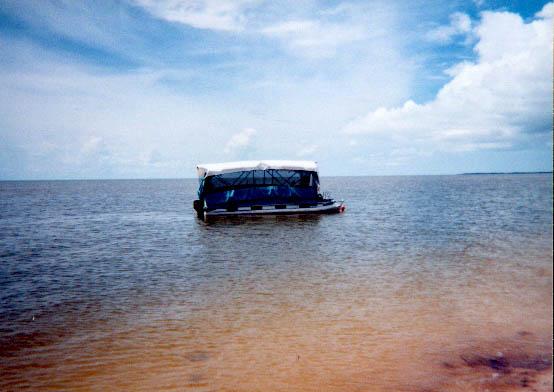
I'm not sure if it was the wind or the thunder that woke me up. Before the rain actually hit, I found I had to keep a leg on the tote box in one corner of the tent, and an arm on the tote in the other corner to keep my tent from folding up around me (and probably dumping the totes open, I was afraid). I knew at this point rain was coming, but I figured with everything but my air mattresses in the waterproof totes, I was ready for it.
DAA-ANG!!! There was no being ready for that storm. Though the weather service had only predicted 10-15 MPH winds, and 15 percent rain for that night, the next morning they reported we had had 55 MPH winds! Holy Hannah! (This storm went on to become tropical storm Hannah).
I now know what it's like trying to camp on a flatbed truck going down the interstate! Of course, I realized I was having a picnic compared to what David and Barb were experiencing aboard the PP!
Imagine a cross between a wind tunnel, car wash, and roller coaster, and you get the idea.
After the rain stopped and wind slacked off, I saw a light through my tent wall. I figured it was the PP, so I got my FRS walkie talkie out of my tote and called David. It seems he had been trying to call for an hour or more. After determining we were each alive, David went to bed.
A while later, I heard the surf sound apparently getting closer. I knew the high tide would be soon, and was concerned that with the wind helping it, it could possibly reach the tents. Shortly after that, I checked on the canoe and noticed that the water was lapping at Jason's tent. We both moved our tents onto the thick grass behind the beach just minutes before the beach was completely washed over.
By morning, things had calmed down to just a brisk breeze. Considering the beating the PP took, it was amazingly intact. Two of the clamps that hold the roof material together were gone, making it impossible to keep out rain (or sun, for that matter).
Jason and I broke camp and loaded onto the PP without even doing breakfast first. We all wanted to get back to Flamingo as soon as practical, and decide what to do next.
David and Barb decided they needed to pull out of the water and leave early since they couldn't replace the clamps. Jason and I discussed various options. After hearing the latest weather report (South to Southwest winds), we decided to go to the nearest chickee north of Flamingo (or Flaming O, as Jason calls it). This is the South Joe River chickee. It's on the southwest side of Whitewater Bay.
After clearing our gear out of the PP we had to do a major repack, since with my weight, Jason's weight, our motor and gas, there was only a 30 lb margin before exceeding the canoe's weight capacity. (Plus, I wanted the center of gravity low in case of rough water - it IS called Whitewater Bay after all.)
And yes, I do "cheat" while in the ENP and run a powered canoe. I often only have a half-day to work with and the nearest campsite north of Flamingo is 12 miles. Whitewater Bay and its associated streams often have horrendous tidal currents which can make for lousy headway.
While I packed the canoe, Jason filed the new permit for South Joe River Chickee. Then I realized I had loaded the canoe on the wrong side of "The Plug" (the dam separating Florida Bay from Buttonwood Canal), and had to unload, move and reload it.
As it turned out, we had some wind, but the water was smooth due to the sheltering shoreline we were able to follow. Also, the tidal current actually worked in our favor. We were in camp within two hours!
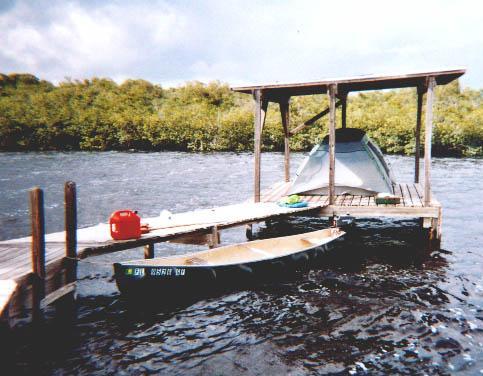
Chickees in the ENP are a modern-day adaptation of the covered stilt platforms the native people of South Florida used to live on. (Where the original chickees used logs and palm fronds, these ENP chickees use conventional lumber and roofing.)
Modern or rustic, the chickee serves the same purpose: a place to stay where no dry land is available, with through-breeze regardless of wind direction. And wind in the Everglades is Mother Nature's DEET. As long as you're in a good breeze, the skeeters can't land.
We spent the rest of the day "power lounging". More than once we commented on what nice conditions David and Barb were missing out on by having to leave. The deeper water, abundance of small islands to duck behind for weather, and yet still wide-open character of Whitewater Bay just cried out to be enjoyed on a boat like the PP. (It's great for canoes too, but with a canoe you are constrained to use the Chickee campsites.)
There was a storm that night to the West again, but we had miles of mangrove windbreak between us and the Gulf this time. With no bugs in the tents and no gale force winds to keep us entertained, Jason and I had the first uninterupted sleep in four days!
The next morning we headed out around 8:45 so we'd have plenty of time to drive home before dark. The weather was also predicted to be yucky, so we wanted to be off the water before by early afternoon. Incredibly, we had the tide current with us again, and we arrived back at Flaming O and had the truck loaded before 11:00!
On arriving at Flamingo, of course I had to put the velcro-wrap towel back on to unload the canoe and load the truck. Too bad. It was nice being among friends for 4 days where being naked was not only not a problem, but was actually encouraged.
I'm looking forward to the next trip. Probably the north end of the park this time, possibly during the lull of visitors between Thanksgiving and Christmas - otherwise after the peak season in May or so. Any one interested? You can email me at 

